
Keep related signals together
Different authentication warnings were tracked together within that context, so subsequent actions could face stronger checks.
April 12, 2026 · Controlled service and route tests
Ardamire Defense Layer
Ardamire is Auxtho's internal defense layer for AI-assisted document workflows and their backend. It grew out of our work on controlled execution and retries.
Our recorded April implementation connected related anomaly signals, targeted holds, replay-evidence checks and separately reviewed defensive changes.
Recorded April 2026 work · Auxtho-owned test environments · Prepared October 3, 2026
Implemented controls / recorded April tests
Within the tested operator and workflow context, related anomaly signals accumulated. Additional verification or a hold governed what could happen next.
Different authentication warnings were tracked together within that context, so subsequent actions could face stronger checks.
April 12, 2026 · Controlled service and route tests
Artifact and export mismatches led to targeted holds. The tests distinguished the affected object from unrelated work.
April 12, 2026 · Controlled service and route tests
Invalid replay results were excluded from accepted replay evidence. Their results and reasons remained available for investigation.
April 13, 2026 · Controlled local workflow
Selected assertions from preserved implementation tests, corroborated by recorded April 12 service/route test runs. These describe tested behavior, not newly captured production traffic or a measured attack-learning rate.
Recorded signals, strengthened checks, enforced holds and prepared investigation evidence.
Reviewed exceptions and authorized consequential defensive changes.
Actual screen excerpts / April 13, 2026
These are cropped original screen records from controlled local tests with seeded test data, not reconstructed UI or footage of a new attack.
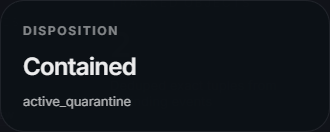
The screen retains the containment state. A hold did not itself resolve or close the incident.
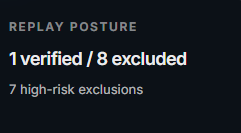
One verified baseline replay remained in accepted evidence. Eight invalid results were excluded, including seven marked high risk. The excluded results and their reasons stayed available for investigation.
Here, “verified replay” means that the result passed integrity and recorded request/execution-binding checks. It does not establish the truth of every AI-generated document or finding.
A separate review for a defensive change
In the recorded local workflow, a disabled defense-rule proposal could return to shadow evaluation only after a request and review by a different authorized person. The requester could neither review nor apply that reactivation; applying it required the approved reviewer. Shadow evaluation assessed the proposal without changing production rules.
Original pixels retained; surrounding internal identifiers removed by cropping. Replay-result counts are not attack counts.
Auxtho-owned live backend / April 15, 2026
An unknown operator or wrong token issuer was rejected. Replay attempts without a required prior step, or after a recorded failure, were rejected. Incident detail stayed available.
Identity, state transitions and permitted requests.
0 expectation failuresRequest methods, body validation and a permitted request.
0 expectation failuresNormal reads and invalid requests under sustained pressure.
0 expectation failuresThree separate recorded suites on Auxtho's own then-live backend. Counts include normal requests; they are not counts of attacks prevented.
The identity/state suite recorded five expected successful requests alongside its rejection checks. After a failure was recorded, another replay was blocked, but the permitted incident-detail read still succeeded.
These steps came from the same recorded incident and request in the identity/state suite—not separate cases assembled into a success story.
Incident intake succeeded.
The sandbox request was recorded.
The required prior step had not occurred.
The request was claimed for execution.
The test's failed execution was recorded successfully—not treated as a successful execution.
The recorded state prevented another replay.
The permitted detail read still succeeded.
All seven expected and recorded status codes matched. These are seven of the existing ten checks, not an additional suite. The identity rejection checks below were separate probes.
| Tested case | Expected | Recorded |
|---|---|---|
| B01 · Identity / stateUnknown operator | Rejected401 | Rejected401 |
| B02 · Identity / stateWrong token issuer | Rejected401 | Rejected401 |
| B03 · Identity / stateReplay before a required prior step | Blocked409 | Blocked409 |
| B04 · Identity / stateReplay after a recorded failure | Blocked409 | Blocked409 |
| B05 · Identity / statePermitted incident-detail read after failure | Succeeded200 | Succeeded200 |
| B06 · Method / schemaDisallowed replay request method | Rejected405 | Rejected405 |
| B07 · Method / schemaReplay request missing required body fields | Rejected422 | Rejected422 |
Tested by Auxtho on its own then-live backend. These seven rows are selected excerpts from two preserved result files; all seven recorded status codes matched their expectations. Case labels are simplified, and internal identities, endpoints and request details are omitted. The downloadable record identifies each selected row. These checks do not measure an overall false-positive rate.
An earlier April 15 mini-soak issued 648 requests and recorded two client read timeouts. After the test client's timeout budget was adjusted, a separate 648-request rerun recorded no expectation failures. That is a changed test condition, not proof that a backend defect was fixed.
The later extended soak shown above comprised 1,296 pressure requests and 124 follow-up requests: 1,420 in total. These distinct runs are not combined into an attack count or learning score.
Connected execution foundations / April 11–12, 2026 KST
EP19 blocker records informed Ardamire's incident and signal-history work while Ardamire development also proceeded in parallel. The related EP19 operator-runtime program tested execution and retry behavior. The original run shown here completed 80 cycles and recorded six scenario failures. After retry handling and test isolation were corrected, the rerun completed 80 cycles with none; scenario allocations changed between runs, so this was not a matched attack-learning comparison.
Failures concentrated in retry creation, acknowledgment-to-retry timing and timeout progression.
Retry creation gained duplicate-request handling; the runtime supervisor was reset between test cycles.
The rerun recorded no scenario failures. Its changed scenario allocations do not establish an attack-learning improvement.
| Phase / test mix | Cycles per run | Original failures | Rerun failures |
|---|---|---|---|
| 0 · Baseline stabilization | 4 | 0 | 0 |
| 1 · Normal / duplicate-heavy | 16 | 0 | 0 |
| 2 · Alert-heavy | 16 | 5 | 0 |
| 3 · Failure / chaos | 20 | 1 | 0 |
| 4 · Mixed soak | 24 | 0 | 0 |
| Total / each run | 80 | 6 | 0 |
Local isolated validation stack. The rerun's observed span was about 19 hours 53 minutes against a configured 20-hour program. Phase mixes differed; scenario allocations changed between runs. This is runtime validation connected to Ardamire's development, not a sequence of Ardamire breaches or a measured attack-learning rate.
EP19 blocker records became inputs to Ardamire's incident, profiling and signal-history work. Ardamire implementation also proceeded in a parallel development session; the EP19 closure was not the start date of all Ardamire work.
The recorded runtime corrections, Ardamire controlled local workflows and own-backend suites are separate evidence sets. Their counts are not combined into one security score.
Read the evidence
The four-page record covers Ardamire's April implementation and tests. The separate web record adds the execution-foundation history shown above.
These are dated implementation and test records, not an independent security certification or evidence of customer-wide protection. They do not establish the readiness of today's hosted restoration.
Model explanation / separate from test evidence
This illustrative sequence explains the control structure. It is not a live incident stream or a replay of the recorded tests above.
Ardamire / six-stage control sequence
Interactive control sequence / modeled signal scenario
A security signal enters the defensive control path.
The affected path enters a hold state while the signal is investigated.
Signal, artifact, and policy context are assembled for review.
A defensive change is prepared as a proposal, not executed.
An accountable person decides whether the proposal advances.
The approved proposal enters a separate verification stage before rollout.
One controlled workflow
Start with one Auxtho-managed workflow. Identify the affected work, the supporting evidence, the responsible reviewer and the verification required before a defensive change advances.
Ardamire's scope is Auxtho's workflow and backend, not the customer's entire security environment.